
Delta Air Lines ranked 13th worldwide for its Delta One business class in the 2026 Skytrax World Airline Awards, despite leading North America. Delta CEO Ed Bastian wants the airline recognized alongside the world’s leading international carriers. Closing this competitive gap requires more than modernized cabins and enhanced amenities. Delta’s leadership must establish which experiences influence international client preference, ensure those experiences can be delivered consistently, and direct investment toward improvements that strengthen competitive performance. P&C Global’s Integrated Product Planning Framework provides the discipline to deliver on those decisions while holding executives accountable for sustainable airline growth and financial returns.
Key Takeaways
Current Context: Delta One Business Class vs. Global Leaders
Delta ranked 13th worldwide for business class and eighth for business-class seats in the 2026 Skytrax World Airline Awards, while leading North America.
Delta’s April 2026 modernization plan targets sliding privacy doors on 90% of Delta One seats by 2030.
Delta’s October 2026 Delta One redesign followed more than 14 months of preparation, 36 dedicated trial flights, and over 200 feedback submissions.
82% of surveyed U.S. airport-lounge customers said lounge access influenced their choice of airline (J.D. Power, 2025).
IATA forecasts global airline returns on invested capital of 4.3% in 2026, against an 8.5% cost of capital (June 2026 outlook).
P&C Global's Point of View
Delta must deliver more than cabin modernization to strengthen global competitiveness grounded in the factors that drive international client preference across the complete journey.
Delta must design a distinctive premium experience that integrates cabin and airport environments, personalized hospitality, amenities, and service to earn international client preference.
With airline returns forecast at 4.3% against an 8.5% cost of capital in 2026, Delta must prioritize investments that generate sustainable incremental financial value.
P&C Global's Integrated Product Planning Framework
Commercial, product, fleet, marketing, service, and finance teams may each develop credible plans, yet their combined decisions can produce a premium offering that fails to meet client expectations or justify its investment.
P&C Global’s Integrated Product Planning Framework connects five leadership decisions to establish what an airline should offer, how it can deliver the promised experience, and which investments create sustainable financial value.
Although Delta One provides the central example, the framework applies to airlines across different markets, operating models, and competitive positions. Its purpose is to help leadership make better product, service, and investment decisions that strengthen passenger preference and financial performance.
Exhibit 1: Applying the Integrated Product Planning Framework to Premium Aviation
| Leadership Decision | Required Evidence | Management Output |
|---|---|---|
| 1. Validate client demand | Purchasing motivations, competitive alternatives, willingness to pay | Scenario-based demand forecasts by client segment and route. |
| 2. Define the premium offering | Cabin features, service expectations, and competitive differentiation | Differentiated product and service offering |
| 3. Align operating capabilities | Aircraft availability, crew readiness, service standards, marketing readiness, and recovery capacity | Integrated product, service, and marketing delivery plan |
| 4. Evaluate investment economics | Fare and load-factor scenarios, end-to-end capital and operating costs, and alternatives | Prioritized investment decisions |
| 5. Establish accountability | Passenger experience, financial results, and decision rights | Named executive owners, launch-readiness criteria, performance thresholds, and corrective actions. |
Each assessment should inform the next. Client demand must shape the offering before leadership determines the operational requirements and evaluates the investments needed to support it.
When evidence falls short, executives must be prepared to refine the proposition, adjust operating plans, redirect capital, or defer commitments. The objective is to strengthen competitive preference and financial performance before costly decisions become difficult to reverse.
1. Validate Demand for a Distinctive Experience
For Delta One, Delta’s international business class, the priority is understanding which cabin features and service experiences motivate clients to choose it over competing alternatives, particularly on international routes. Preferences and competitive offerings vary by client segment, cabin class, and route, requiring leadership to distinguish experiences customers nominally appreciate from those that significantly influence purchasing decisions.
Research reinforces the importance of looking beyond the aircraft cabin. According to J.D. Power’s 2025 U.S. Airport Lounge Benchmark, 82% of surveyed lounge customers said lounge access influenced their choice of airline, while 47% considered access to a preferred lounge when selecting flight routes. Although the study did not isolate international business-class travelers, its findings demonstrate that experiences outside the cabin influence airline selection. For Delta, leadership must evaluate the complete client journey—from booking and departure lounges to inflight hospitality, arrival procedures, baggage handling, and service recovery—to identify which elements strengthen competitive preference.
Thoroughly Research End-to-End Passenger Preferences
Singapore Airlines demonstrates how structured research can inform major premium investments. In November 2026, the airline announced more than S$2 billion in long-haul cabin investments informed by research involving over 5,000 travelers, employees, and industry experts. Through surveys, interviews, focus groups, and concept testing, Singapore examined how passengers work, dine, relax, and rest, shaping new designs emphasizing privacy, comfort, and flexibility.
Delta has also invested in research and operational testing. Its October 2026 Delta One redesign followed more than 14 months of preparation, including 36 dedicated trial flights and over 200 feedback submissions. However, the airline’s publicly disclosed research does not establish the relative importance of individual improvements in winning customers from competitors or generating incremental financial returns.
Quantify Which Improvements Win International Bookings
Delta should conduct comprehensive, route-specific competitive assessments spanning booking, airport lounges, cabin environments, dining, hospitality, arrival, and service recovery. Choice-based conjoint analysis can quantify how different passenger segments trade off features, service levels, and prices. For example, leadership could test whether additional seat space creates greater purchasing preference than faster check-in, improved dining flexibility, or more reliable baggage handling.
These findings should inform scenario-based forecasts comparing Delta One’s existing and proposed offerings against competitors, estimating changes in bookings, willingness to pay, client retention, and competitive switching. Leadership should validate those forecasts against actual purchasing behavior wherever possible. The objective is to identify which improvements materially strengthen international client preference before committing additional capital.
2. Define a Delta One Business Class Offering Clients Will Choose
Understanding client preferences and competitive landscapes is only the first step. Leadership must translate that evidence into a differentiated premium offering, determining which cabin features and service experiences should be standard, which warrant personalization, and where variations are commercially justified.
For Delta One, this means designing the complete premium experience, from booking and airport services to onboard hospitality, arrival, and service recovery, rather than treating individual improvements as separate initiatives. The objective is not to match every feature offered by competing airlines, but to establish an integrated experience that earns client preference throughout the journey, including when disruptions occur.
This requires designing the experience at a more granular level, including menus, materials, amenities, sensory environments, service protocols, and the interactions that shape how clients perceive the airline throughout their journey.
How Does Delta One Compare With the Best Business Class Airlines?
Delta’s October 2026 service redesign represents an effort to strengthen Delta One’s competitiveness through greater personalization. The airline expanded meal preselection, including gluten-free and lighter options, with entrée choices available until 18 hours before departure. Customers prioritizing rest can skip the morning meal and receive a lighter offering before arrival. Redesigned tableware and more personalized dining service further support the intended experience.
While Delta’s approach represents a step in the right direction, comparison against recognized global leading carriers illustrates the significance of the remaining gaps. Singapore Airlines introduced its Book the Cook program in 1998 and currently allows eligible Business Class passengers to select main courses up to six weeks before departure. Customers can also request to skip meal service to rest without interruption. However, dining flexibility represents only one component of a much broader premium experience.
Singapore Airlines extends its brand identity through a signature scent in airport lounges and distinctive music played during boarding and landing. Qatar Airways combines Qsuite privacy with personalized dining, Diptyque amenities, and dedicated turndown service. At the first-class level, Air France’s La Première features seasonal menus developed by Michelin-starred chefs, Bernardaud Limoges porcelain, and Christofle cutlery. These details demonstrate how leading airlines differentiate through the integration of sensory design, luxury materials, culinary offerings, amenities, and personalized service.
Where the 2026 Skytrax Rankings Show Delta One’s Gaps
The 2026 Skytrax World Airline Awards reveal competitive gaps beyond cabin configuration. Delta ranked eighth worldwide for business-class seats but 13th for its overall business-class offering, while failing to place among the top ten airlines for onboard catering or comfort amenities. Qatar Airways ranked first overall and for business-class seats, while Singapore Airlines and Cathay Pacific placed second and third overall. In the separate global cabin crew rankings, Cathay ranked first and Singapore second, while Delta led North America. Although these passenger-voted rankings do not establish the causes of Delta’s competitive position or its financial returns, they identify dimensions of the premium experience that leadership must evaluate beyond cabin modernization.
For Delta, matching established conveniences such as meal preselection meets baseline expectations rather than creating competitive differentiation. Closing the broader gap requires a distinctive, end-to-end premium experience that gives international travelers compelling reasons to choose Delta One over leading competitors.
P&C Global helps airlines validate passenger demand, define differentiated premium offerings, and align fleet, service, and marketing to deliver them consistently.
3. Make the Premium Promise Deliverable Across the Network
Defining a distinctive premium offering is only the beginning. To compete with the world’s leading international business-class carriers, Delta must ensure that customers consistently receive the Delta business class experience they expect across its network.
Differences in cabin configurations and service offerings are not inherently a weakness. They become a commercial risk when customers cannot clearly identify what they are booking or receive an experience that falls short of expectations. Leadership must align product commitments with the airline’s ability to deliver them reliably as its fleet and service offerings evolve.
Will Customers Receive the Delta One Suites They Book?
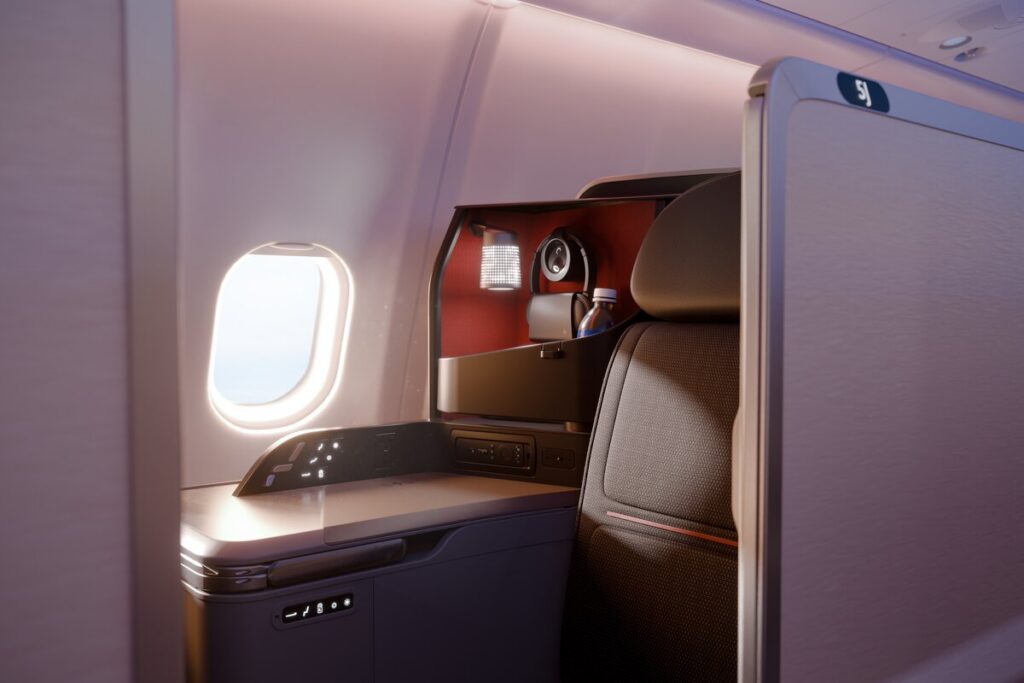
Delta’s April 2026 modernization announcement includes next-generation Delta One suites on Airbus A350-1000 aircraft and upgrades to its A330-200/300 fleet, targeting sliding privacy doors for 90% of Delta One seats by 2030.
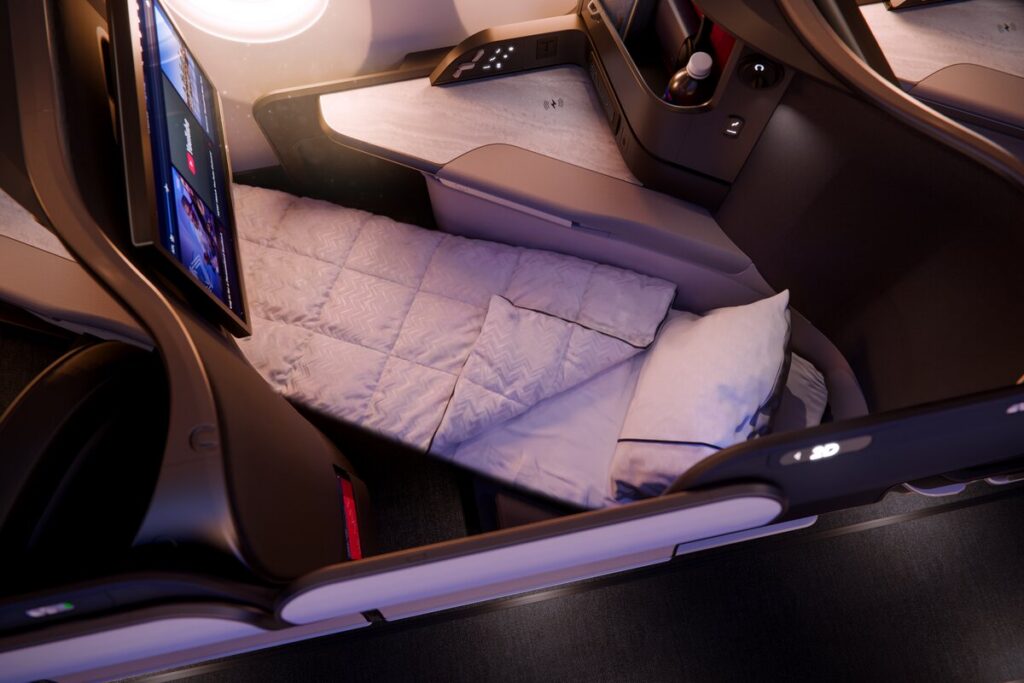
However, fleet modernization targets do not guarantee that customers will receive the premium cabin features they selected when booking. Under Delta’s International Contract of Carriage, the airline may substitute aircraft and change seat assignments without guaranteeing the originally scheduled configuration. A passenger booking a Delta One suite with a privacy door could therefore be reassigned to an aircraft offering a materially different cabin experience. This creates a risk that customers will not receive the features that influenced their purchasing decisions, undermining client confidence and the credibility of Delta’s premium offering.
How Cathay Pacific and Qatar Airways Protect Cabin Commitments
Leading international carriers demonstrate how cabin commitments can be managed at the flight level. In March 2026, Cathay Pacific identified specific Hong Kong–Los Angeles flights scheduled to receive its new Aria Suite, providing customers with greater visibility into product availability.
Qatar Airways advises customers to verify Qsuite availability when booking and recognizes that aircraft substitutions can affect the experience. Its reported conditional rebooking policy for eligible substitutions further illustrates the importance of protecting the premium product commitment.
These practices demonstrate that cabin modernization must extend beyond aircraft investment to what customers can reliably book and receive. For Delta, leadership must determine which existing configurations remain competitive, ensure material cabin differences are communicated accurately, and align aircraft deployment with the premium experience being sold.
Marketing and communications must also be integrated into product launches. Delta should develop targeted campaigns that communicate the premium offering’s distinctive benefits to relevant passenger segments, while ensuring promotional claims accurately reflect the experience available on specific aircraft and routes. Launch readiness must therefore include both operational capability and marketing alignment, preventing public commitments from exceeding what the airline can reliably deliver.
Delta should measure how consistently customers receive the cabin features presented at booking, rather than focusing exclusively on fleet modernization targets. When aircraft substitutions materially change the experience, timely communication and appropriate remedies are essential to protecting client confidence and the integrity of the Delta One offering.
Build the Capabilities to Deliver Personalized Service
Premium service extends across check-in, lounge access, boarding, onboard hospitality, flight reliability, arrival, and disruption recovery. Although different functions manage these activities, passengers experience them as one journey.
Delta’s redesigned dining and hospitality offering requires coordination across provisioning, service timing, and crew execution. Greater personalization also places additional demands on employees to recognize client preferences, respond attentively, and exercise sound judgment.
Emirates demonstrates the importance of developing these capabilities. In October 2025, the airline opened its Centre of Hospitality Excellence to support nearly 25,000 cabin crew through training modeled on Michelin-starred hospitality. The program includes immersive fine-dining experiences, culinary instruction, and personalized service training that teaches employees to anticipate passenger needs, recognize subtle cues, and adapt their approach to individual preferences.
Emirates also demonstrates how service capabilities can produce measurable operating results. Its 2025–2026 annual report disclosed that meal-demand forecasting across more than 300 flights achieved 99.1% first-choice meal availability while reducing food waste by 42 tonnes annually. These results illustrate how customer preferences, operational data, and provisioning decisions can improve service fulfillment and resource efficiency.
How Delta’s Service Compares in Global Cabin Crew Rankings
Independent assessments highlight the remaining competitive challenge. In the 2026 Skytrax cabin-crew rankings, Singapore Airlines placed second globally, Qatar Airways twelfth, and Emirates fifteenth, while Delta did not appear among the top 20 despite leading North America. These results suggest that Delta’s regional service recognition has yet to translate into comparable global recognition. Leadership must evaluate where its premium service experience falls short, particularly in personalization, attentiveness, service consistency, and recovery.
Leadership must align staffing, training, provisioning, and service timing with the experience promised to clients.
Frontline employees also need the judgment and authority to personalize service, respond to individual needs, and resolve problems without unnecessary delays. When failures occur, complex cases require clear ownership and follow-through. Compensation alone does not establish that passenger confidence has been restored.
Delta must evaluate whether its service capabilities consistently deliver the attentive, personalized experience promised to international clients. Without that consistency, improvements in dining and hospitality risk becoming isolated enhancements rather than a distinctive premium offering.
4. Put Capital Behind the Highest-Value Improvements
Once leadership has established the offering and the capabilities required to deliver it, the next decision is how much to invest and where. Premium competitiveness requires investment in both physical products and service capabilities. A more expensive cabin or expanded hospitality offering does not automatically create greater financial value. Capital should follow the incremental economic opportunity, not simply the availability of new technology or amenities.
The airline industry’s history reinforces why investment discipline is essential. According to IATA’s June 2026 Global Outlook for Air Transport, global airline returns on invested capital are forecast to decline to 4.3% in 2026, against an estimated 8.5% cost of capital. This 4.2-percentage-point shortfall reflects a longstanding industry challenge in generating sufficient returns for investors. For Delta, the implication is clear: premium investments must do more than improve the passenger experience or generate additional revenue. Leadership must demonstrate that each investment can produce incremental contribution and sustainable financial returns sufficient to justify the capital committed and alternatives forgone.
Compare Investments Across the Premium Experience
Executives must determine whether to accelerate cabin refurbishment, redeploy upgraded aircraft, invest in airport gates and lounges, strengthen service capabilities, or defer investment. Each alternative carries different capital requirements, operating costs, implementation risks, and potential financial returns.
Emirates demonstrates the scale and complexity of cabin modernization. Its $5 billion retrofit program covers 219 aircraft, with refurbishment typically requiring 18 days for a Boeing 777 and 22 days for an Airbus A380. These commitments demonstrate why airlines must evaluate not only the capital required for cabin improvements but also aircraft availability and the operating consequences of refurbishment.
More extensive upgrades are not always the appropriate investment. The International Air Transport Association’s cabin retrofit guidance explains that different cabin components warrant different replacement cycles. It also illustrates how customized seat development and major cabin modifications can introduce substantial engineering and certification lead times, making existing certified products or more limited improvements viable alternatives.
Service investments require equivalent consideration. Training, provisioning, frontline technology, and recovery capabilities may improve client preference without the capital costs and aircraft downtime associated with extensive refurbishment.
For Delta, leadership must identify whether competitive weaknesses arise from cabin limitations, service execution, or both. Investment priorities should reflect the expected improvement in client preference and incremental financial value, rather than assuming that comprehensive cabin modernization will always produce the strongest return.
Prioritize Investments by Passenger Segment & Route
Delta must prioritize cabin and service investments where they can generate the greatest incremental financial value. Competitive conditions vary substantially across its international network. During the 12 months ending July 2026, Delta operated 100% of nonstop flights between Atlanta and Cape Town, compared with approximately 10% between New York JFK and London Heathrow. These figures measure Delta-operated flight frequency, not total market share, premium passenger demand, or the broader commercial presence of its Virgin Atlantic joint venture. They illustrate why leadership must evaluate competitive conditions and investment opportunities at the route level rather than rely on a uniform modernization timetable.
Consider two hypothetical international routes awaiting cabin upgrades. One faces strong competition from airlines offering newer premium products and serves clients willing to pay more for privacy, comfort, and sleep quality. The other faces limited nonstop competition and continues to attract profitable demand with its existing configuration. Although both may generate substantial revenue, their potential returns from modernization could differ significantly.
The first route may warrant earlier investment if upgrades can attract profitable bookings otherwise lost to competitors. The second may remain competitive through targeted service improvements, allowing capital to be directed elsewhere. Leadership must prioritize investments according to their potential to strengthen client preference, protect pricing power, and generate incremental financial value.
Evaluate Full Investment Economics
Once investment priorities are established, executives must determine whether the expected financial benefits justify the capital required and the alternatives forgone. Strong client demand or competitive pressure alone does not establish a sound investment case.
Investment decisions must account for the complete passenger experience, from booking and departure lounges to inflight service, arrival, and recovery. On the revenue side, Delta should model how alternative offerings affect realized fares, premium cabin load factors, client retention, and competitive switching by route. On the cost side, executives must consider aircraft orders, cabin and lounge upgrades, technology, transition costs, and ongoing labor and material expenses. These assessments must establish whether the expected improvements in client preference, service delivery, and purchasing behavior generate sufficient incremental contribution and financial returns to justify the investment.
Implementation risks can materially affect those economics. Cirium’s August 2026 analysis of Emirates’ refurbishment program found that A380 aircraft spent an average of 52 days on the ground during retrofits in 2025, with some projects incorporating additional maintenance. These findings reinforce the importance of accounting for aircraft downtime, additional maintenance requirements, and delayed deployment when evaluating the full financial consequences of premium cabin investments.
Separate Incremental Growth From Shifted Revenue
Executives must distinguish genuine incremental growth from revenue shifted within the airline. An upgraded Delta One cabin that attracts existing customers from another Delta premium product may generate less additional contribution than its revenue suggests. Conversely, postponing improvements can sacrifice profitable international bookings to competitors.
Investment approval should depend on expected incremental contribution, cash returns, capital requirements, and the risks associated with each alternative. Leadership must challenge assumptions about demand, achievable pricing, implementation costs, and financial returns before committing capital.
Where the evidence supports investment, leadership should proceed. Where expected returns fall short, executives must reconsider the scope, pursue more attractive alternatives, or defer commitments. The objective is to maximize sustainable financial value, not simply accelerate cabin modernization.

P&C Global helps airlines evaluate full investment economics, prioritize capital by route and segment, and hold leadership accountable for results.
5. Hold Leadership Accountable for the Experience Clients Receive
A premium strategy succeeds when executives can demonstrate that the experience delivered meets client expectations and generates the intended commercial results. Leadership needs evidence from normal operations, examined by route, aircraft configuration, and client segment. Network-wide averages can conceal weaknesses affecting valuable customers and markets.
Connect Performance Evidence to Corrective Decisions
Executive scorecards should connect actual customer experiences, operating performance, and commercial results to specific management actions.
Emirates’ 2025–2026 annual report provides an example of connecting customer experience to commercial performance. The airline reported a 10% increase in customer lifetime value and 10% growth in repeat bookings through its digital channels. Although these figures cover its broader business and do not isolate premium cabins, they demonstrate the importance of measuring customer relationships and purchasing behavior alongside service performance. Delta should apply the same discipline to international Delta One clients, examining whether improvements strengthen repeat purchasing, competitive preference, and realized financial returns.
| Performance Area | Evidence Leadership Should Monitor |
|---|---|
| Product fulfillment | Booked-versus-delivered cabin features and material aircraft substitutions |
| Service experience | Passenger-reported attentiveness, fulfillment of preferences, and recurring hospitality failures |
| Operating reliability | Seat defects, entertainment failures, and service interruptions |
| Client preference | Repeat purchases, competitive switching, and share of premium spending |
| Client recovery | Resolution effectiveness, retention after complaints, and restored relationships |
| Financial performance | Incremental pricing, contribution, program costs, and investment returns |
These measures should guide management decisions and drive corrective action when performance falls short. Persistent cabin discrepancies require changes to deployment or the commercial offering. Recurring hospitality failures demand a review of staffing, training, service processes, and frontline authority. When clients shift spending to competitors, commercial leadership must reassess the proposition. Investments that underperform require review before additional capital is committed.
Closing a complaint is insufficient evidence of recovery if the passenger subsequently chooses another airline. Leadership must determine whether corrective actions restore client confidence, strengthen competitive preference, and deliver the intended commercial results.
Establish Executive Ownership
Senior executives must recognize that their personal travel experiences may not reflect the service ordinary customers receive. Executives recognized by flight attendants may receive more attentive treatment, making those observations an unreliable measure of service consistency. Delta’s leadership should supplement firsthand experience with independent assessments of normal Delta One journeys, direct client feedback, and objective comparisons with leading international business-class carriers. Before claiming global premium leadership, executives must understand where Delta One meets or falls short of competitors in cabin quality, service, reliability, and client preference. These findings should guide the decisions needed to close competitive gaps and strengthen the airline’s international position.
Accountability must extend across the functions responsible for delivering the premium experience. Commercial leadership should own the client proposition and evidence supporting demand. Product and fleet leaders must ensure cabin configurations and aircraft deployment support that proposition. Marketing and communications leaders must build awareness among target passenger segments while ensuring promotional claims reflect actual product availability and service capabilities. Service and operations leaders should be accountable for hospitality standards, frontline capabilities, and effective recovery. Finance must independently evaluate investment assumptions and realized returns.
The CEO and executive leadership team must resolve competing priorities, challenge performance assumptions, and determine when commitments should proceed, change, or stop. Their responsibility extends beyond approving the strategy to ensuring that Delta One delivers an experience competitive with leading international carriers and generates the intended financial results. When performance falls short, executives must require corrective action and verify that improvements produce measurable outcomes.
Premium Leadership Requires Better Decisions, Not Just Better Cabins
Delta’s ambition to compete with the world’s leading international business-class carriers demands more than modernized cabins and enhanced service. Leadership must establish what earns client preference, consistently deliver experiences that meet global competitive standards, and direct investment toward improvements that generate sustainable financial returns.
P&C Global’s Integrated Product Planning Framework provides the discipline to make those decisions. It connects validated client demand to a differentiated offering, aligns operating capabilities with the experience promised, evaluates the full economics of investment alternatives, and establishes executive accountability for results. It also requires leadership to challenge assumptions and redirect commitments when the evidence warrants a change in strategy.
Delta’s progress should ultimately be judged by whether international travelers choose Delta One business class over leading competitors and consistently receive the experience they expect, and whether those choices generate financial returns that justify the capital invested. That is how Delta can turn its global premium ambitions into a competitive position it has demonstrably earned.
Delta One Business Class FAQs
What is Delta One?
Delta One is Delta Air Lines’ business class, offered on international routes. Delta is upgrading it with next-generation suites on Airbus A350-1000 aircraft, targeting sliding privacy doors on 90% of Delta One seats by 2030, and launched a redesigned dining and service experience in October 2026 that expands meal preselection.
Is Delta One business class or first class?
Delta One is business class. Skytrax assesses it against other airlines’ business-class products: in the 2026 World Airline Awards, Delta ranked eighth worldwide for business-class seats and 13th for its overall business-class offering. Delta’s domestic First Class is a separate cabin.
How does Delta One rank among the best business class airlines?
In the 2026 Skytrax World Airline Awards, Delta ranked 13th worldwide for business class and eighth for business-class seats, while leading North America. Qatar Airways ranked first, followed by Singapore Airlines and Cathay Pacific. Delta did not place among the top ten airlines for onboard catering or comfort amenities.
What are Delta One suites?
Delta One suites are business-class seats with sliding privacy doors. Delta’s April 2026 plan adds next-generation suites on Airbus A350-1000 aircraft and upgrades its A330-200/300 fleet, targeting privacy doors on 90% of Delta One seats by 2030. Its Contract of Carriage does not guarantee the scheduled cabin configuration.
Is Delta One worth it?
It depends on the aircraft, route, and service a traveler receives. Delta has invested in new suites and redesigned dining, yet the 2026 Skytrax rankings show gaps against global leaders in catering, amenities, and cabin-crew recognition. Consistent delivery across the network will determine how international travelers judge its value.