On October 22, 2026, Kering reported that Gucci’s comparable retail sales fell 9% in the third quarter even as conversion, average selling price and average transaction value improved. The people who came through the door were more inclined to buy. The more consequential question concerns the clients who had stopped coming, including those who could afford anything Gucci made.
In Milan that September, Demna staged his collection inside a meticulously furnished imaginary Gucci store. It was a shrewd choice of setting. By the time a client sees a collection in a real boutique, several executives have already decided which version of Gucci that client will encounter. Which pieces reach the rail, at what price and with whose client in mind can determine whether anyone returns the following season.
Key Takeaways
Current Context: Gucci’s Creative Direction and Retail Sales
- In fiscal 2018, Gucci attributed 62% of sales to millennials and 35% to Chinese clients. The two groups overlap.
- Gucci’s reported revenue reached €10.49 billion in 2022 and fell to €5.99 billion in 2025. Its recurring operating margin fell from 35.6% to 16.1% across those years.
- In April 2026, Gucci put iconic designs at 10% of leather goods and set a 20% ambition for 2030.
- For Q3 2026, Kering reported €1.291 billion of Gucci revenue, down 4% as reported and 6% on a comparable basis.
P&C Global’s Point of View
- A house can win a new generation and keep its best clients. Trouble starts when gaining one requires those already buying to change their tastes with each appointment.
- Leadership should establish which products and services clients expect to survive a creative succession. Their absence can cost Gucci the next appointment before an advisor has the chance to make a sale.
- Judge the reset by the return and subsequent full-price purchases of identifiable clients. Fashion coverage and a strong opening week answer different questions.
What Changed Between Michele, De Sarno and Demna?
Count from Alessandro Michele’s appointment in January 2015 and Gucci has had three permanent creative leads and two handovers within that group. Include the change from Frida Giannini to Michele and the period contains three successions. Gucci’s design studio also presented an interim collection in 2025. A runway chronology matters commercially because one director’s merchandise can still be on the floor after the next has taken responsibility.
The contrasts come into focus through a familiar object. A client can recognize the metal bar and rings of a Horsebit loafer across a room. Whether the shoe is backless, stacked on a platform or worn with a pencil skirt changes who can imagine buying it and where they would wear it. For leadership, that is an assortment decision as much as a matter of taste.
Three Creative Directors, Three Invitations to the Client
Alessandro Michele Made Eccentricity Commercially Powerful
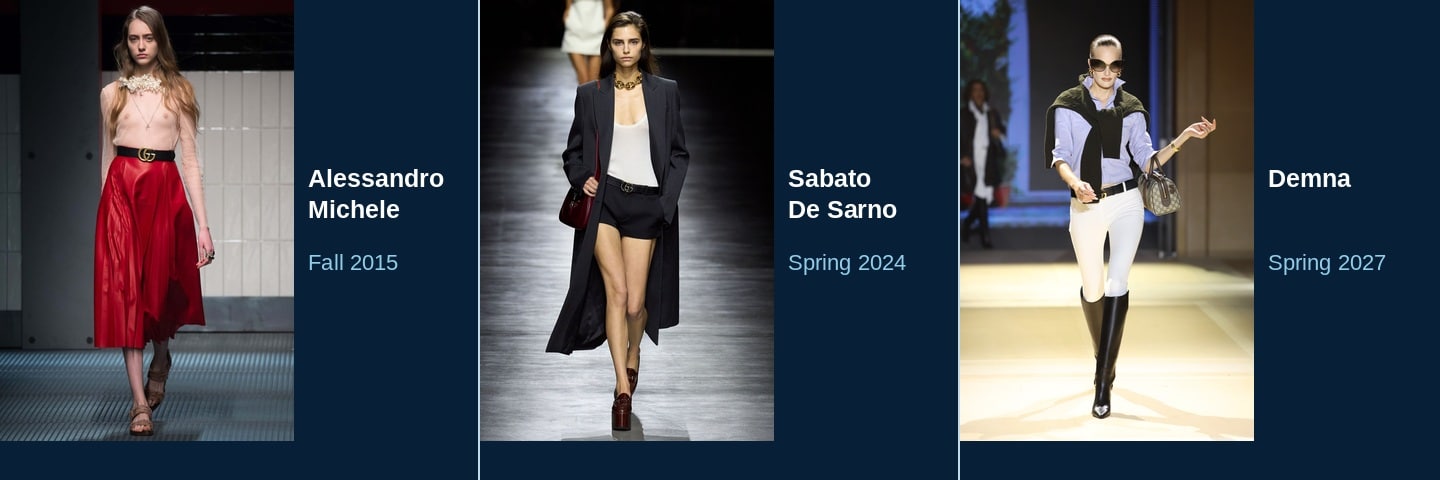
Michele, a Gucci insider who had worked under Giannini, filled the runway with romantic blouses, vintage references and deliberately unconventional combinations. The 2015 debut invited men and women to borrow from one another’s wardrobes. Michele’s fur-lined backless loafer made an old house signature instantly recognizable to a new audience. The commercial achievement was substantial. Reported revenue rose from €3.90 billion in 2015 to €10.49 billion in 2022, the year he left.
Sabato De Sarno Asked for a Different Kind of Attention
Announced in January 2023, De Sarno opened his September debut with a long gray coat, white tank, short shorts and a GG belt. Against Michele’s layering, the Ancora collection asked a client to notice the line of a coat, the length of a hem and a deep red. Restraint can appeal to an established collector. It also puts a garment into direct competition with every other house that makes an exceptional coat. The advisor must be able to explain why this one belongs in a Gucci wardrobe.
Demna Combined Provocation With Familiar House Signatures
De Sarno’s February 2025 departure preceded Demna’s July 2025 arrival. Demna’s September 2026 show set sharp tailoring and evening glamour alongside sportswear and overt branding. His Generation Gucci campaign had already changed the proportions of the Jackie and sharpened the shape of the Dionysus. The offer also reaches well upmarket. The Business of Fashion reported an oversized crocodile Jackie in the Generation Gucci lookbook. A house genuinely intent on reaching younger buyers can still make a compelling piece for an established collector. The decisive edit takes place when the buying team chooses what each boutique will actually carry.

P&C Global helps luxury leaders connect creative choices with client demand, assortment and investment.
How Much Did Gucci Lose as Its Audience Changed?
Gucci’s revenue fell €4.50 billion between 2022 and 2025. Recurring operating income declined from €3.73 billion to €966 million, a drop of about 74%. That gap between the rates of decline matters. The operating commitments of a global house, including stores, collections and communications, continue even when fewer clients come in to buy.
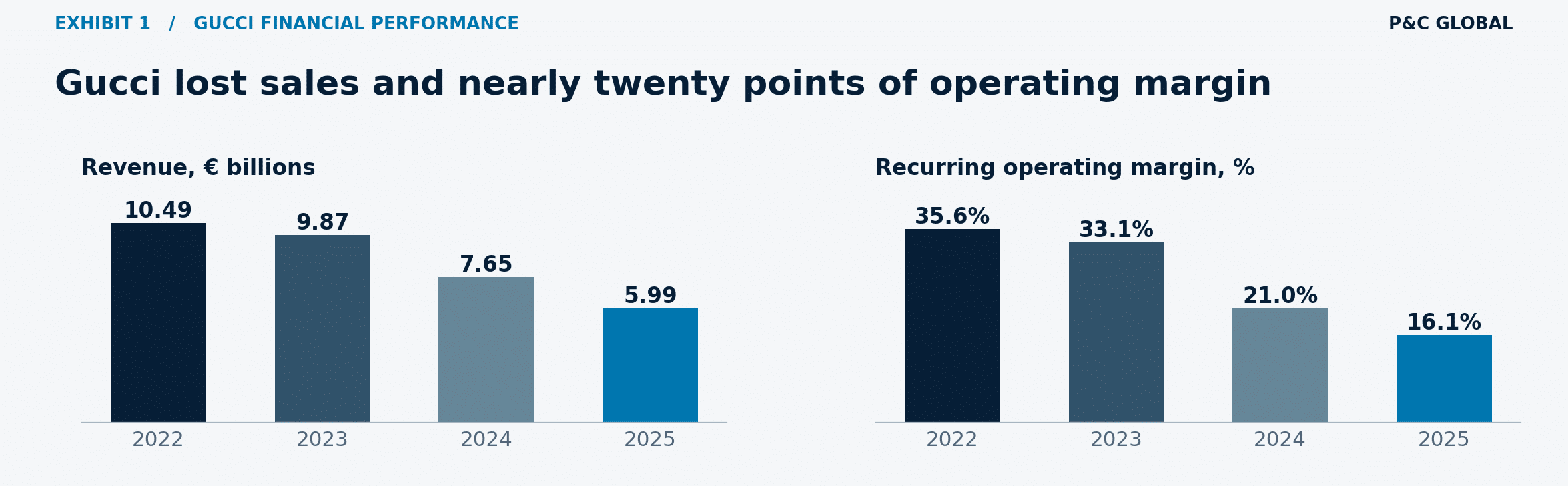
Gucci’s revenue fell 43% from 2022 to 2025. Its recurring operating margin contracted 19.5 percentage points.
Source: P&C Global calculations using Kering’s 2023 and 2025 full-year results.
View the data behind Exhibit 1
| Year | Revenue (€ billions) | Recurring operating margin |
|---|---|---|
| 2022 | 10.49 | 35.6% |
| 2023 | 9.87 | 33.1% |
| 2024 | 7.65 | 21.0% |
| 2025 | 5.99 | 16.1% |
The steepest margin decline came before Demna arrived. Between 2023 and 2024, sales fell from €9.87 billion to €7.65 billion and recurring operating margin fell from 33.1% to 21.0%. The annual accounts span several collections, executives, price decisions and trading environments. Assigning the entire loss to his aesthetic, or to either predecessor, would obscure the decisions a board can address now. One is the breadth of the range that remains recognizably Gucci between collections. Another is whether a price change makes sense to a client who remembers what a comparable piece used to cost.
What Do the Chinese and Millennial Figures Actually Tell Us?
Gucci’s 2018 investor materials show the success of Michele’s appeal to millennials and Chinese nationals worldwide. Nationality tracks a person across shopping destinations. It gives little indication of income, taste or where a transaction took place. A young Chinese client purchasing exceptional leather goods in Paris can be a collector. A middle-income American buying a first belt is making a different decision. Both can care deeply about design. Aspirational buyers worldwide face a separate constraint: a change in price may put the next purchase beyond reach even when the design still appeals.
Gucci’s 2018 investor day also reported similar retention rates for millennials and non-millennials in its 2017 full-price directly operated business. That historical finding is a reason to resist an easy explanation of the subsequent decline. Recruiting younger buyers was commercially sound. The risk was allowing the visibility of particular looks, and the sales they generated, to become a substitute for understanding what held other clients’ wardrobes together.
Did Gucci’s Changing Aesthetic Drive Away Wealthy Clients?
A house can lose a longstanding client without ever recording a complaint. Consider a collector whose advisor once set aside a particular leather, a restrained Jackie or a precisely fitted jacket. After several seasons in which the invitations feature pieces the client would never wear, checking the next collection stops being worth an afternoon. The advisor at a competing house gets that appointment. The longer the absence, the less current the original advisor’s knowledge becomes.
There is evidence of a wider loss of shoppers. Consumer Edge’s analysis of its 2024 transaction panel found shopper counts weakening across income groups, even as spending per transaction and purchase frequency among remaining Gucci customers held up. The distinction matters. A boutique can remain highly productive with the clients it still sees while losing relationships at the affluent end of the market. Kering has disclosed pressure on traffic and a plan to rebuild loyalty. Its public results do not quantify the loss of ultra-wealthy longtime clients or attribute departures to a designer. To find out, leadership would need the purchase histories and candid explanations of clients who have gone quiet, including some who decline the invitation to return.
China Also Changed Around Gucci
Bain estimates that the mainland Chinese personal luxury goods market fell 17%–19% in 2024 and another 3%–5% in 2025. Domestic brands gained share by responding to local tastes. For an affluent collector, that creates another credible destination for the same purchase. In April 2026, Kering CEO Luca de Meo acknowledged that Gucci had relied too heavily on outlets in China and needed to serve buyers who placed greater weight on quality, design and the experience in store. A new aesthetic by itself cannot fix the location of a boutique or restore confidence in its full prices.
The point has practical consequences. In Q3 2026, Kering singled out lower traffic in mainland China and Japan and described North America as Gucci’s most resilient region. A regional director who sees a slowdown in Shanghai should distinguish a client who bought in Europe, one who switched houses and one who has cut discretionary spending. Only the client who switched houses has necessarily awarded the purchase to a competitor. Each warrants a different conversation.
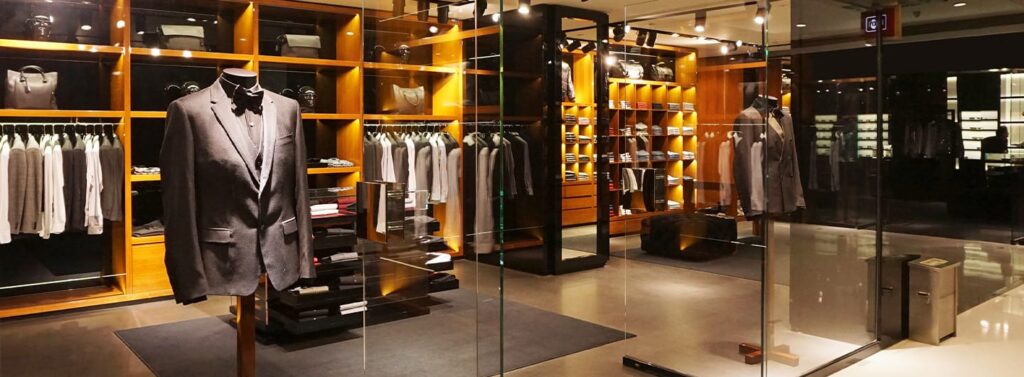
P&C Global’s luxury retail team helps leaders connect boutique evidence, client behavior and regional merchandising decisions.
What Evidence Should Change Gucci’s Strategy?
Start With the Choice Gucci Has Put Before Investors
In April 2026, Gucci outlined a sequence that first engages fashion leaders and subsequently earns the loyalty of more discerning buyers. It also set an ambition for very important clients to approach 25% of the business. Demna’s fashion reach serves an explicit purpose in that plan. The risk lies in expecting a collector who feels overlooked to wait while a house builds its audience elsewhere.
Gucci has an opportunity to serve both groups now. In November 2026 at Shanghai’s China International Import Expo, it presented the Bamboo 1947 alongside GucciCore. A heat-shaped bamboo handle gives an advisor something precise to discuss with a collector who remembers an older bag. The new collection gives a prospective buyer an invitation into the same history. Which pieces the two clients ultimately order, and whether either comes back, would tell executives more than attendance at the exhibition.
Use Peers to Isolate the Question Gucci Must Answer
In the same quarter that Gucci’s retail sales fell 9%, Kering’s other Fashion & Leather Goods houses together grew retail sales 2% on a comparable basis. Kering described strong engagement from top clients at Bottega Veneta and from both top and core clients at Saint Laurent. The difference in mix and scale limits a direct comparison. It does establish that clients were still buying from other houses facing many of the same regional conditions.
Bottega Veneta gives selected bags an ongoing Certificate of Craft care service. That creates a concrete reason for contact after a sale and a way for an advisor to learn what the owner values with use. For Gucci, the equivalent question is what the house can offer an existing owner that another seasonal invitation cannot. An inspection, a fitting or a preview chosen specifically for that client can reopen a conversation on its own merits.
Gucci Must Give Its Best Clients a Reason to Return
The creative director owes Gucci a point of view. The CEO owes its clients a house they can still recognize when the creative director changes. That requires keeping enough of the archive alive in the assortment, giving advisors discretion over what they present and finding out why a once-reliable client now spends elsewhere. For the board, an informative comparison would be full-price contribution from clients who bought through two or more creative eras against buyers acquired during a single one, allowing for tenure and normal purchase frequency. The first sign of progress will be a former client choosing to make time for Gucci again. The commercial proof will come with the purchase after that.
Part two, How Gucci Can Bring Clients Back Through the Door, examines the choices in merchandising, appointments and capital allocation that can turn a return visit into a lasting relationship.
Gucci Creative Direction FAQs
Who is Gucci’s current creative director?
Demna is Gucci’s artistic director. Kering announced his appointment in March 2025, effective in early July. His Spring/Summer 2027 show in Milan staged the collection inside a model Gucci store, bringing his ideas for clothing, accessories and the boutique environment together in one presentation. Source: Kering
Who was Gucci’s creative director before Demna?
Sabato De Sarno led Gucci’s creative direction from 2023 until February 2025. His first collection, Ancora, emphasized shorter silhouettes, tailored outerwear and a distinctive deep red. He succeeded Alessandro Michele, whose eclectic combinations and reinterpretation of Gucci signatures had brought a younger generation into the house. Source: Gucci succession announcements
Why are Gucci sales down?
Kering identified weak traffic as the principal constraint in the third quarter of 2026. Gucci’s comparable retail sales fell 9% even as conversion and average ticket improved. Lower traffic weighed on mainland China and Japan. The group also cited a tougher comparison and a smaller lift from new products than in the preceding quarter. Source: Kering quarterly results
Is Gucci losing popularity?
Popularity depends on what is measured. In April 2026 Gucci described itself as the second best-known luxury house worldwide and among the top five for desirability, down from first several years earlier. A famous name can still lose visits and sales. Repeat full-price purchases would show whether renewed interest is commercially durable. Source: Kering investor presentation