On October 22, 2026, Kering reported €120 million in quarterly Gucci wholesale revenue, up 45% on a comparable basis, alongside a 9% decline in comparable retail sales. A wholesale partner can place a larger order before a single former client has walked back into a Gucci boutique. For Kering’s leadership, the question is which decisions will make the end client want to come back and which evidence justifies funding those decisions across the network.
In Paris, Gucci now has a particularly good place to find out. Its 1,480-square-meter Avenue Montaigne flagship includes a private Appartamento. A private room gives an advisor the means to serve a collector well. It gives the collector little reason to make the trip until there is something specific to see. Part one examined how creative succession changed the clientele Gucci was inviting. Here the test moves to what happens when an advisor picks up the phone.
Key Takeaways
Current Context: Gucci’s Retail Turnaround
- In April 2026, Gucci said it had already cut its stock-keeping units by 20% as part of a wider assortment reset.
- In Q2 2026, Gucci recorded €1.275 billion in directly operated retail sales, down 2% on a comparable basis as the Borsetto and Paparazzo launches gained traction.
- In Q3 2026, Gucci’s comparable retail sales fell 9%. Conversion, average price and average ticket improved, and traffic remained the main constraint.
- In Q3 2026, Gucci’s €120 million of wholesale revenue represented 9% of house sales. Kering cited an easy comparison and the timing of orders for new collections.
P&C Global’s Point of View
- Recover the reason to visit before buying more traffic. An invitation earns the client’s time when an advisor can name the piece, the reason it fits and when it will be ready.
- Give creative, merchandising and store leaders one financial test. Can they generate additional full-price contribution from the clients a particular boutique can serve?
- Invest in a wider rollout once a group of returning clients has had enough time to make a second purchase and the additional contribution covers the cost of serving them.
What Would a Gucci Retail Recovery Look Like?
A store can improve conversion while its business contracts. Suppose a boutique had 1,000 visits, converted 20% into purchases and took €1,000 per transaction. That yields €200,000. At 800 visits, 22% conversion and a €1,050 ticket, sales are €184,800, down 7.6%. These are illustrative figures. Kering has not disclosed the changes in Gucci’s traffic, conversion and ticket needed to reconstruct actual comparable sales.
The management implication is specific. Before increasing the marketing budget, identify which visits disappeared. A closed store diverts some traffic. A tourist may shop in another city. An advisor’s departure can break a relationship. A former top client may have looked at a collection online and decided there was no reason to book. A regional total cannot tell a CEO which of these problems requires investment.
1. Who Should a Gucci Boutique Invite Back?
Reconstruct the Relationship Before Contacting the Client
Start with the clients each advisor would once have expected to hear from by now. Compare current inactivity with each person’s buying history. A client who bought ready-to-wear every season and missed two collections warrants earlier attention than a collector who commissions a significant piece once every three years. In both cases, check purchases across stores, e-commerce and countries before declaring the relationship dormant.
Then give the advisor a question worth asking. Did the client stop finding the right product? Did a preferred advisor leave? Was the client buying for an occasion that has passed? An advisor who has maintained the relationship can ask directly and record the answer in the client’s own words. Respect contact preferences and give the client an easy way to decline. A candid refusal is more valuable than an appointment secured by repeatedly calling.
Make the Invitation Specific Enough to Decline Intelligently
Consider two hypothetical clients in Shanghai. One owns an earlier Bamboo bag and has passed on the last two runway previews. A private look at a new handle finish alongside an archival example gives her a reason to meet. The other discovered Gucci through a Demna collection and wants to try a jacket seen online. Confirm the size and arrange a fitting. Neither age nor nationality tells the advisor which invitation to send.
Regional retail leadership should track qualified visits consistently across both cases. Count an attended visit with a stated product or service interest and count each visit once. Keep outreach, bookings, attendance and transactions as separate stages. Otherwise a store with a popular event can appear to have rebuilt relationships before an advisor has had a single substantive conversation.
P&C Global helps luxury retailers connect client history, advisor judgment and service capacity across boutiques and digital channels.
2. Which Products Justify a Visit at Full Price?
Gucci’s April plan set out a €2,000–€3,000 mid-price proposition in leather goods, a renewed entry offer and a more distinctive top tier. It also called for iconic designs to double their share of leather goods to 20% by 2030. The most consequential decision for a merchant is what earns the space released as the number of styles comes down.
Give Each Price Step a Purpose the Client Can See
Take the Jackie. In March 2026, The Business of Fashion reported U.S. prices of $1,690 for a small Jackie, $2,450 for a Jackie Slim and a starting price of $3,450 for the Jackie 1961. These were different versions offered at the time. Displaying them together gives an advisor a chance to explain what changes with size, construction and intended use. A client who cannot see the difference may reasonably question the higher price.
Before the next buy, the merchandising director should ask each store which requests it could fill, which it referred elsewhere and which were lost. A classic that sells out early can look less productive in season-end sales than a new bag that sat on the floor for twelve weeks. Compare full-price demand per week available, including unfilled requests. Allocate limited depth first where demand and the ability to serve it are both evident.
Localize Depth While Keeping the House Recognizable
Paris may need more capacity for visiting clients seeking an immediate purchase. A neighborhood boutique may know well in advance which resident collectors want to see an exceptional finish. Treat these as hypotheses for the respective stores to test. Give the local merchant authority to move stock within limits and measure whether transfers fulfill genuine demand. Moving an unsold bag between stores should never count as selling one.
3. Can Gucci Deliver the Appointment It Promises?
A private room is a fixed investment. A held appointment requires several people to get small things right on the same afternoon. The named piece must be physically available, the right advisor must have time, and any tailor or specialist needed for the decision must be on hand. One failed promise can make the next invitation harder to accept, especially for a client who had already drifted away.
The Paris flagship and the 109-square-meter womenswear boutique at Harrods make the trade-off tangible. Both express Demna’s retail concept at very different scales. London need not replicate the Appartamento to keep a promise. A reserved size, a reliable transfer and an advisor who knows exactly when the piece will arrive can make a compact boutique more useful to a particular client than a much larger room.
Put the Store Director in Charge of the Whole Appointment
Give the store director a weekly view of requested pieces, reserved inventory, advisor hours, fitting rooms and specialist availability. Have the advisor reconfirm the item before asking a client to travel. Where a promise looks doubtful, offer a later appointment or an alternative visit while the client can still change plans. Record the reasons for cancellations separately from no-shows. A stock failure belongs with merchandising and logistics.
Recruitment also deserves its own capacity. Ring-fencing every attractive slot for existing collectors limits the chances of discovering the next one. Reserve some appointments for new clients with a concrete interest and compare full-price repeat purchases across both groups. For a young first-time client, a thoughtful fitting and a follow-up when the matching piece arrives may matter more than an elaborate event.

P&C Global helps luxury retail executives compare store productivity, incremental contribution and the cost of delivering a higher service standard.
4. Where Does a Wholesale Order Become Consumer Demand?
Kering reported that Gucci’s wholesale and other revenue rose 35%, while wholesale alone rose 45% in Q3 2026. A merchandise delivery is revenue for the house under its wholesale arrangements. The retailer’s sale to its customer is a later event. Ask each material partner for opening stock, receipts, full-price unit sales, returns, markdowns and closing stock by product and week. Reconcile those records before increasing the next order.
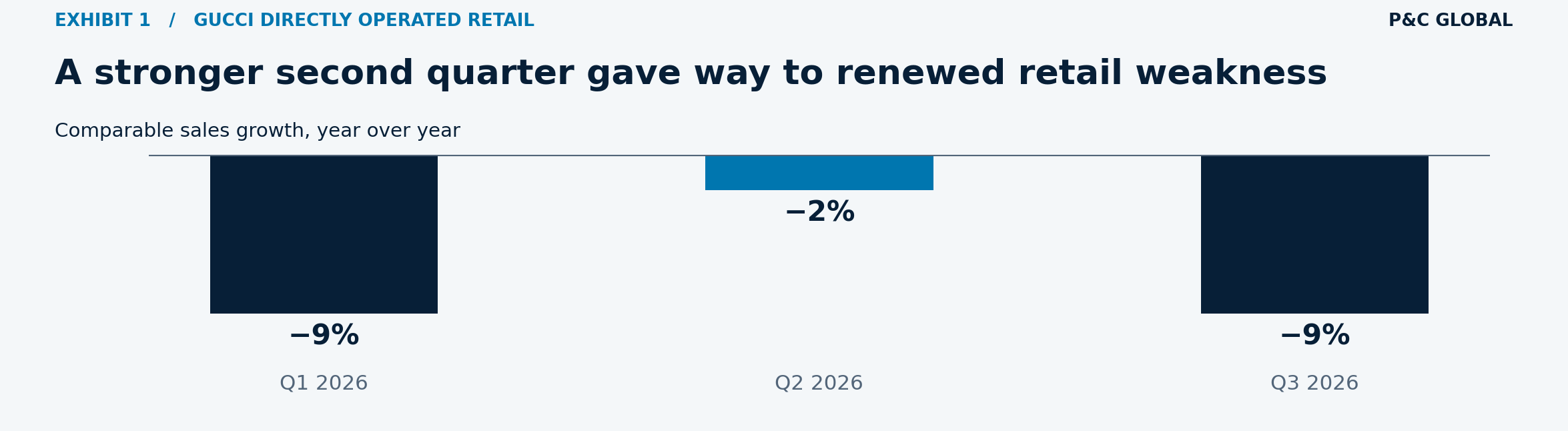
Gucci’s comparable directly operated retail sales fell 9%, 2% and 9% in successive quarters of 2026. In Q3 the house also recorded 45% comparable wholesale growth on a low base.
Source: P&C Global analysis of Kering’s first-half and third-quarter results.
View the data behind Exhibit 1
| Quarter | Comparable retail sales growth (YoY) |
|---|---|
| Q1 2026 | −9% |
| Q2 2026 | −2% |
| Q3 2026 | −9% |
Follow the Product Through a Second Order
A reorder for the same bag at the same price, after a partner has sold the first delivery, is more informative than an opening order built around a show. Ask whether the reorder replaces genuinely sold units, supports a new location or moves stock between doors. A strong first shipment followed by transfers and markdowns can leave the house recording revenue while the client learns to wait for a discount.
These distinctions should govern allocation. If a new line sells through quickly at full price in two stores and sits in the others, transfer units to the stores with evidenced demand before commissioning a wider production run. Where strong partner sales coincide with lower directly operated sales in the same city, look for channel substitution. An apparently successful launch can move an existing client to a lower-contribution channel.
Which Measures Belong on the Retail Director’s Dashboard?
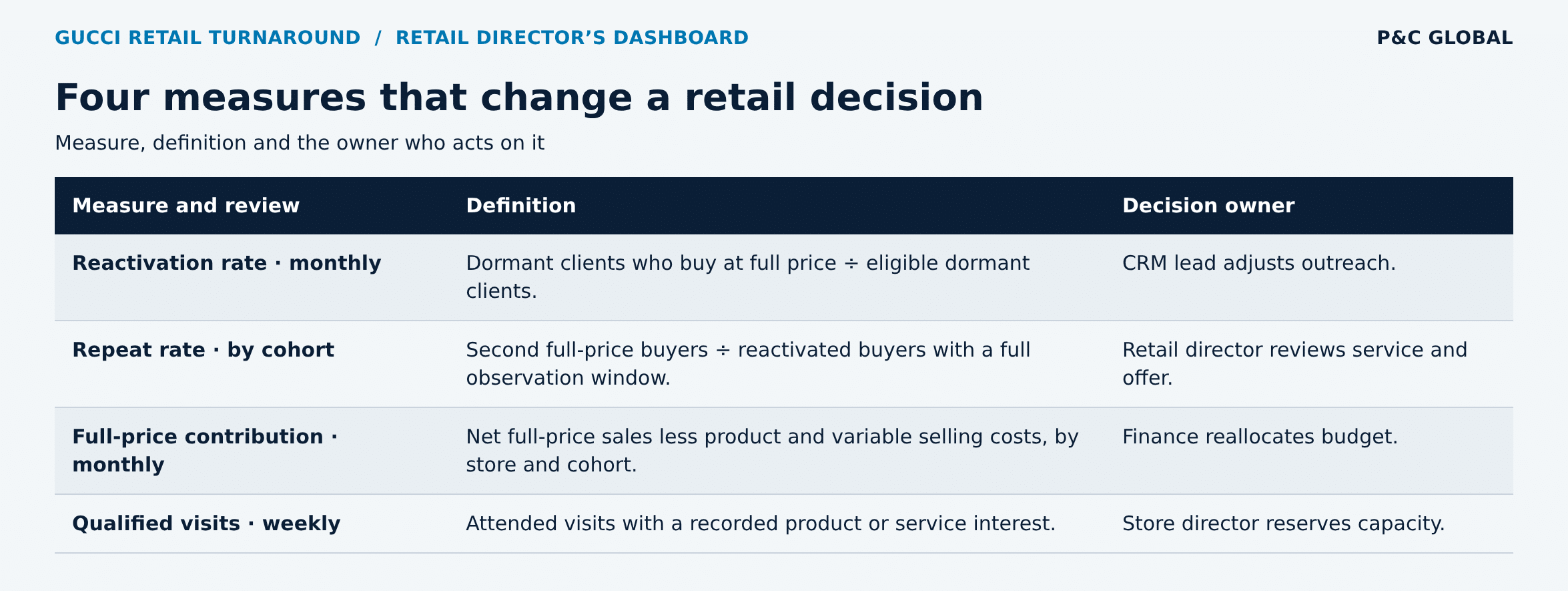
Four measures, each tied to the owner who acts on it.
Source: P&C Global.
View the data behind Table 1
| Measure and review | Definition | Decision owner |
|---|---|---|
| Reactivation rate · monthly | Dormant clients who buy at full price ÷ eligible dormant clients. | CRM lead adjusts outreach. |
| Repeat rate · by cohort | Second full-price buyers ÷ reactivated buyers with a full observation window. | Retail director reviews service and offer. |
| Full-price contribution · monthly | Net full-price sales less product and variable selling costs, by store and cohort. | Finance reallocates budget. |
| Qualified visits · weekly | Attended visits with a recorded product or service interest. | Store director reserves capacity. |
A dashboard earns its place when a metric changes a decision. If booked appointments rise but attendance falls, fix availability and follow-up before adding more invitations. If attendance and sales improve while returns rise, inspect fit, quality and advisor incentives before expanding the offer.
5. Which Stores Have Earned the Next Investment?
Make a Second Purchase and Incremental Contribution Visible
For each store and client group, track eligible dormant clients, qualified visits, reactivated clients who buy at full price and their subsequent repeat rate. Define repeat as a second, separate full-price purchase within a stated window after reactivation. Use only clients who have had the full window to mature. Give infrequent collectors a longer view alongside the operating dashboard. Otherwise the apparent loss of an annual buyer can be an artifact of the calendar.
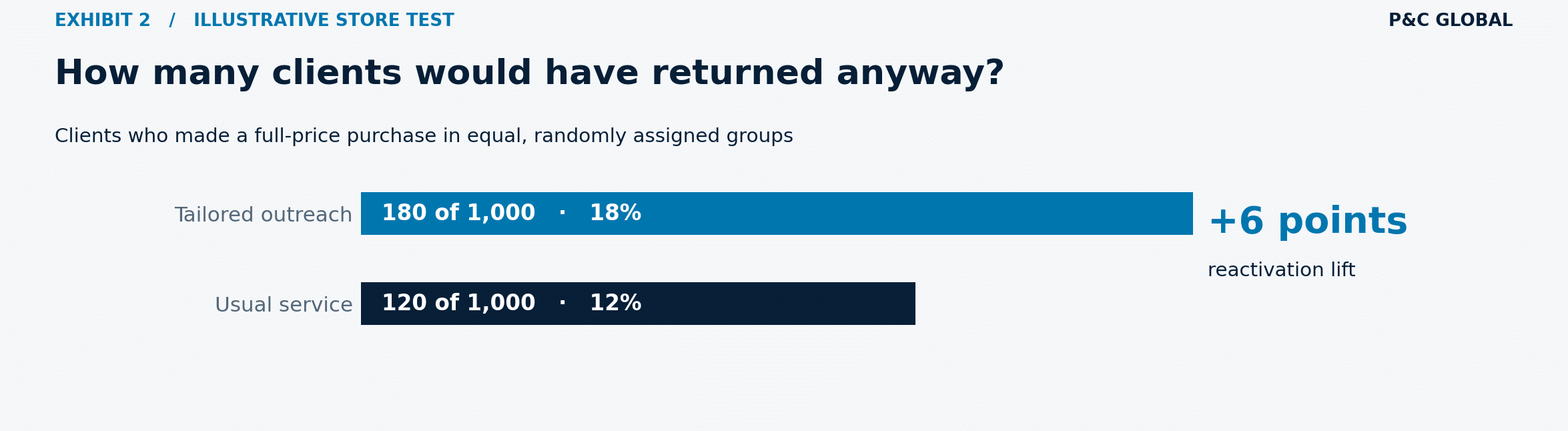
In an illustrative test, 1,000 eligible clients per group produce 60 incremental full-price buyers. Whether the program creates value also depends on the contribution per buyer and the cost of outreach.
Source: P&C Global illustrative analysis. All assumptions are hypothetical.
View the data behind Exhibit 2
| Group | Eligible clients | Full-price buyers | Reactivation rate |
|---|---|---|---|
| Tailored outreach | 1,000 | 180 | 18% |
| Usual service | 1,000 | 120 | 12% |
| Incremental lift | 60 | 6 pts |
Suppose comparable clients are randomly assigned to tailored outreach or usual service. If 180 of 1,000 in the first group buy and 120 of 1,000 in the second group buy, outreach earns credit for an estimated 60 incremental buyers. At €600 contribution per incremental buyer before program expense and €24,000 incremental cost, the pilot earns €12,000. Break-even requires 40 incremental buyers, or a four-percentage-point lift. A small change in response could reverse the decision.
Finance should use actual net sales after returns, deduct product cost, commissions and incremental fulfillment, then charge outreach, specialist time and events once. Compare contribution per eligible client as well as per buyer. Check for sales displaced from another store, channel or later period. Quantify uncertainty in the lift before committing to a permanent increase in staffing or space.
Set a Decision Date Before Expanding the Pilot
During the first 30 days, reconcile client histories and establish store baselines. In the following 60 days, test a limited number of propositions with the inventory and appointment capacity to deliver them. At day 90, the regional president and CFO can decide which offers merit another round. Expansion should wait for a mature repeat cohort and a credible return after costs. A campaign that fills the calendar but misses its contribution threshold needs to change.
Gucci’s Turnaround Will Be Earned One Client at a Time
A Gucci client who returns after years away brings a memory of what the house once did exceptionally well. The advisor who listens can learn which part of that memory still has commercial value and where the new collection offers something better. The second appointment tests whether the house has acted on what it heard.
Kering can already see that Gucci converts more of the traffic it gets. Its next investment decisions should follow the stores that can identify whom they brought back, show what those clients bought at full price and demonstrate that the relationship remained profitable after the opening event was over.
Gucci Retail Turnaround FAQs
What is luxury clienteling?
Luxury clienteling is the work an advisor does to develop an individual client relationship over time. At Gucci, a useful example would be reserving a particular Jackie for someone who collects that line, arranging an appointment with the piece in hand and following up on what the client valued after using it.
What is retail conversion rate?
Retail conversion rate is the share of store visits that result in a purchase, using consistent traffic and transaction definitions. Kering reported improved conversion at Gucci in Q3 2026 despite a 9% comparable retail sales decline. A boutique can convert a higher share of a smaller audience and still lose revenue. Source: Kering
What is sell-through in retail?
Sell-through measures how much merchandise a retailer actually sells to end customers relative to the units available during a defined period. For a Gucci launch, track full-price sales net of returns against opening units plus receipts. Track markdown sales separately so discounting cannot disguise weak demand at the intended price.
How can a luxury brand win back lost customers?
Identify clients whose absence exceeds their usual buying interval, check whether they bought elsewhere in the network and ask what changed. An advisor can then offer a specific product or service. The commercial test is whether more clients return and buy again at full price than would have done so under usual service.
How do you calculate repeat purchase rate?
Divide the number of reactivated buyers who make a subsequent qualifying purchase by the number of reactivated buyers who have had the full observation period. Define the window and price basis in advance. Gucci could use a shorter view for frequent fashion clients and a longer one for occasional collectors.